
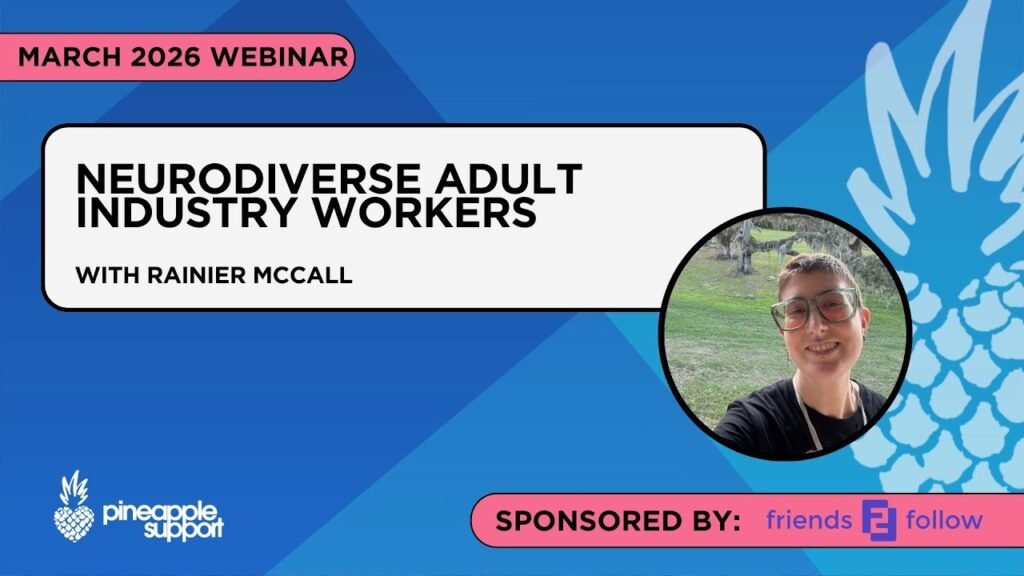
In brief: In a Pineapple Support webinar (March 29), counselor Rainier McCall argued that flexible, asynchronous adult work fits many neurodiverse people, and criticized age-verification and payment-processor pressure.
Contains adult themes: the embedded podcast video discusses adult-industry work.
There is a long-running joke that half the industry has ADHD. A Pineapple Support counselor took the question seriously in a 49-minute talk.
The webinar, “Neurodiverse Adult Industry Workers,” went up on the Pineapple Support YouTube channel on March 29. The description credits Rainier McCall as presenter. McCall introduced themself as a Florida licensed mental health counselor, an EMDR consultant and a qualified supervisor, attached to Pineapple “since 2018. That’s my story and I’m sticking to it.”
A spectrum, not a sentence
McCall started by defining the term broadly: an “umbrella” that can include ADHD, autism, Tourette’s, OCD, PTSD, dissociative disorders and brain injuries, or, in everyday shorthand, just ADHD and autism. The main point (5:08): “these are just natural variations in brain functioning.”
The examples were cats. One watches the drain every night while the litter box cleans itself; another gets upset only at sneezes of a certain pitch. We go easy on animals’ quirks, McCall said, and much harder on our own. On terms such as identity-first or person-first language, the advice was to use what feels right to you.
Why adult work fits
McCall said the jobs call for “fluidity,” quick wit and fast persona shifts. They also offer things office jobs often don’t: flexible hours, working from home, comfort items, choosing your own clothes, room for mobility aids, consent-based rules on communication, and asynchronous work such as texting and custom content in place of the “snap snap” of live calls. Corporate life, by contrast, meant “fluorescent lights” and being expected to answer an email “in two seconds.” McCall said they sometimes use a cane or a wheelchair, too.
so generally um at least from many people that I’ve spoken to you know sex work and adult work moves with the needs of the worker.
McCall stressed it is not all sunshine. Some people do this work out of necessity, McCall said, and pointed to card processors and age-verification rules as heavy weights on the industry: “most of the time these laws do not seem to be at all about protecting children.”
The closing advice was to use tools that help you, whether or not you have a diagnosis. Using a fidget toy because it’s cute, McCall said, means “you’re not taking the last fidget toy” from someone who needs it.
McCall’s credentials match public listings on Psychology Today and Inclusive Therapists, which place McCall’s practice in St. Petersburg, Florida; the Inclusive Therapists profile lists the adult industry among McCall’s specialties. The claims about why neurodiverse people go into this work are McCall’s professional opinion; the talk cited no prevalence data, and McCall called parts of it “just my opinion.” Pineapple Support is a nonprofit that offers free and low-cost therapy to adult-industry workers.
So the hiring requirements are wit, flexibility and a high tolerance for chaos, and the HR department turns out to be two cats and a self-cleaning litter box. That explains a lot.